Greenwich, CT · Fairfield County · Westchester
Historic Slate Roof Restoration in Greenwich, CT
The Greenwich Slate & Cedar Roof Guide explains historic slate roof restoration for homeowners in Greenwich, CT and surrounding towns including Stamford, Darien and New Canaan.
Historic slate roof restoration keeps as much of the original roof as possible: sound slates are salvaged and relaid with new copper nails, failed slates are replaced from a matching quarry, and flashing, hips and ridges are rebuilt to the original pattern. Targeted work typically runs $2,000–$8,000; a full strip-and-relay is priced closer to a new slate roof. The National Park Service's guidance is to repair historic slate rather than replace it wherever possible.
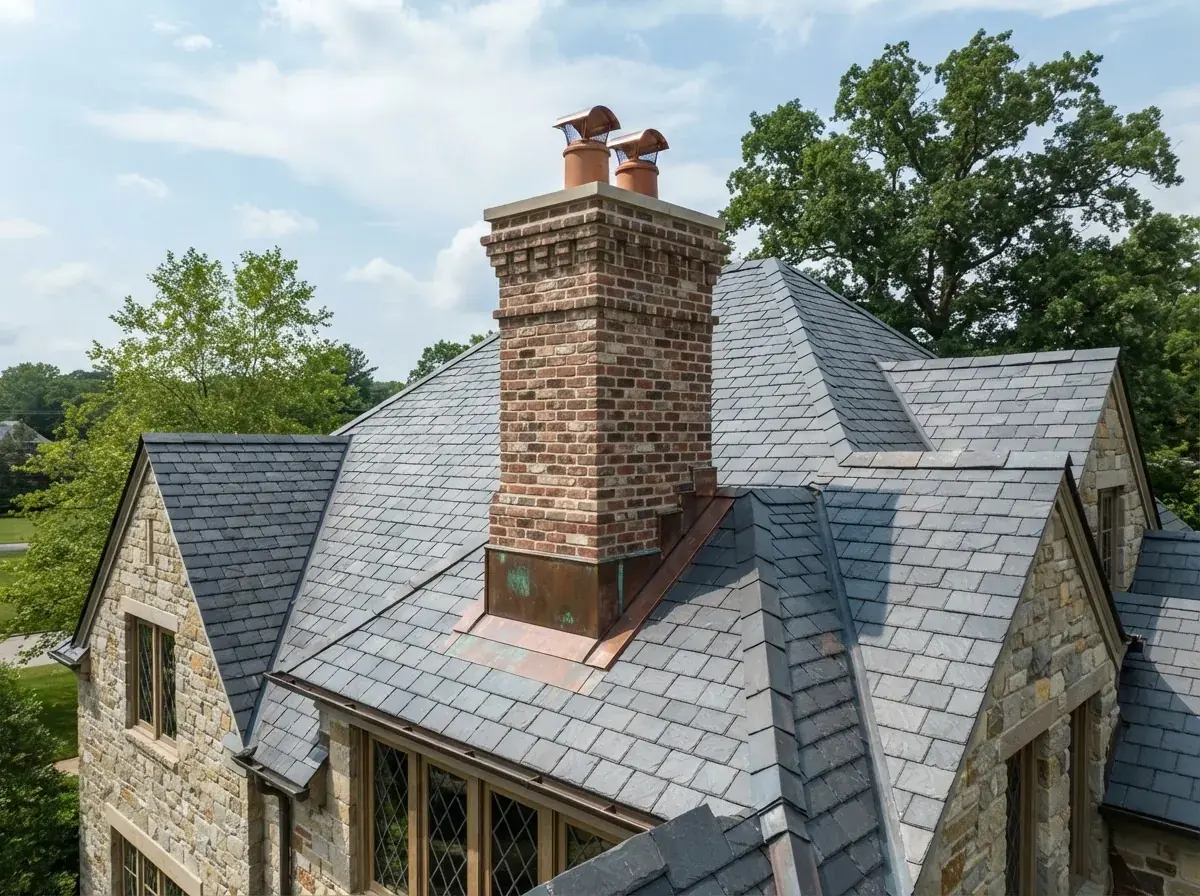
- Original slate salvaged and relaid
- Quarry, color and pattern matched
- Period copper and ridge details rebuilt
- Planned around historic district review
Types of Historic Slate Roof Restoration
Strip and relay
When the slate is sound but the nails have rusted through, the whole roof is stripped, slates are sorted and stacked, new underlayment and copper flashing go on, and the original slates go back with copper nails.
Partial restoration
The worst elevations are restored first, often the south and west slopes that take the most weather, while the rest is repaired and monitored.
Pattern and color restoration
Many Victorian and Tudor Revival roofs have bands of fishscale or octagonal slates, or mixed colors laid in patterns. Missing pieces are cut and matched so the pattern reads correctly again.
Copper and metal details
Built-in gutters, copper ridges, finials, cresting and flashing are repaired or remade to the original profile.
Graduated slate roofs
Graduated roofs use thicker, larger slates at the eaves and smaller ones near the ridge. Restoring them means keeping each slate in its course, which takes careful sorting during strip-off.
How Historic Slate Restoration Works
- Condition survey. Each roof slope is assessed for slate condition, nail failure, flashing, gutters and deck. Photos and notes record the existing pattern, exposure and details before anything is touched.
- Slate identification. The quarry and color are identified so replacements can be matched. Salvaged slate from the same region often matches best.
- Salvage plan. A count of how many slates are likely to be reusable, and how many new or salvaged slates must be sourced.
- Approvals. If the house is in a local historic district, the town's commission may need to approve the work, especially any change of material, color or detail.
- Restoration. Removal in sections, deck repair, new underlayment, copper flashing, and relaying with copper nails.
- Record. A final set of photos and notes on the slate source, which helps with every repair for the next century.
Historic Districts in Greenwich and Nearby Towns
Local historic districts are different from National Register listing. National Register status recognizes a building or district but generally doesn't restrict what a private owner does with their own money. A local historic district is set up by the town, and exterior changes there usually need a certificate of appropriateness before work starts.
- Greenwich has local historic districts including Strickland Road, Round Hill Road/John Street and Stanwich, plus individually designated properties.
- New Canaan's Historic District around God's Acre regulates exterior features through its Historic District Commission.
- Stamford reviews alterations in its local historic districts under its zoning regulations.
Like-for-like slate repair usually draws little scrutiny. Swapping natural slate for synthetic, changing the color, or removing decorative details is where approval is most often needed. Rules change, so the town is always the final word.
Common Details on Historic Slate Roofs
Older homes in Greenwich, Stamford and New Canaan show a few recurring details worth recognizing before work starts, because each one has to be rebuilt the same way:
- Built-in (Yankee) gutters hidden in the eave and lined with copper or terne. When the lining fails, water runs straight into the cornice.
- Saddle and comb ridges made of slate rather than metal, which need slates cut and fitted in pairs.
- Open and closed valleys: open valleys show a strip of metal, closed valleys bring the slates together. Switching one for the other changes the look of the roof.
- Patterned bands of fishscale, diamond or hexagonal slates, often in a second color.
Historic Slate Restoration Cost
| Work | Typical range |
|---|---|
| Targeted restoration: flashing, valleys, chimney and slate | $2,000–$8,000 |
| Small slate repairs on a historic roof | $500–$2,500 |
| Full strip-and-relay or new slate (per sq ft) | $30–$60 per sq ft |
Ranges are typical for Fairfield County and Westchester in 2026 and are for planning only. They are not quotes; the real price depends on the roof, access and materials.
Restoration is labor-heavy: slates come off by hand and are sorted, so a strip-and-relay can approach the cost of new slate. The payoff is keeping original stone that can't be bought new, and a roof that looks right on the house.
Why Restoration Usually Beats Replacement on Older Homes
The National Park Service's Preservation Brief 29 makes the case plainly: the pattern, detailing and craftsmanship of a slate roof are part of a historic building's design, so slate roofs should be repaired rather than replaced whenever possible. It also notes copper and terne as the flashing metals historically used with slate.
There's a practical side too. Many slates on early-1900s roofs are still hard, sound stone; what failed were iron nails and thin flashing. Replacing that good stone with new slate spends money to throw away material that would have lasted another 50 years. Read NPS Preservation Brief 29.
Historic Slate Roof Restoration: Common Questions
Can original slate be reused?
Yes, usually. On many older roofs most slates are still sound. They are removed, sorted, and relaid with copper nails, with matched slate filling in for broken pieces.
Does a historic district need to approve slate roof work?
Sometimes. Like-for-like repair often needs little or no review, but changing material, color or details in a local historic district usually needs approval from the town's historic district commission. National Register listing alone generally doesn't require town approval.
Is restoration cheaper than a new slate roof?
Often, but not always. Targeted restoration is far cheaper than replacement. A full strip-and-relay is labor-heavy and can approach the cost of new slate, but it keeps original stone and details that can't be bought new.
Is synthetic slate acceptable on a historic home?
It depends on the town. Some historic district commissions accept synthetic slate on some buildings, others don't. The National Park Service's view is that natural slate is preferred on historic buildings where the original roof was slate.
Before you hire
Check the Contractor First
Roofing on an existing home is home improvement in Connecticut: the contractor must be registered with the Department of Consumer Protection and show the HIC number in its ads and contract. Westchester County licenses home improvement contractors the same way.
- Look up a Connecticut HIC registration
- Search Westchester County licences
- Questions to ask a slate or cedar roofer
This site is an independent guide. It doesn't perform roofing work or recommend a particular company.