Greenwich, CT · Fairfield County · Westchester
Chimney Flashing Repair in Greenwich, CT
The Greenwich Slate & Cedar Roof Guide explains chimney flashing repair for homeowners in Greenwich, CT and surrounding towns including Stamford, Darien and New Canaan.
Replacing the flashing around a chimney typically costs $1,200–$4,000 in Fairfield County and Westchester, usually done in one or two days. It's the right fix when a leak shows up on the ceiling or wall near the chimney, especially in wind-driven rain. On a slate or tile roof, the surrounding slates or tiles have to be lifted and reset, so this is work for a roofer who handles those materials.
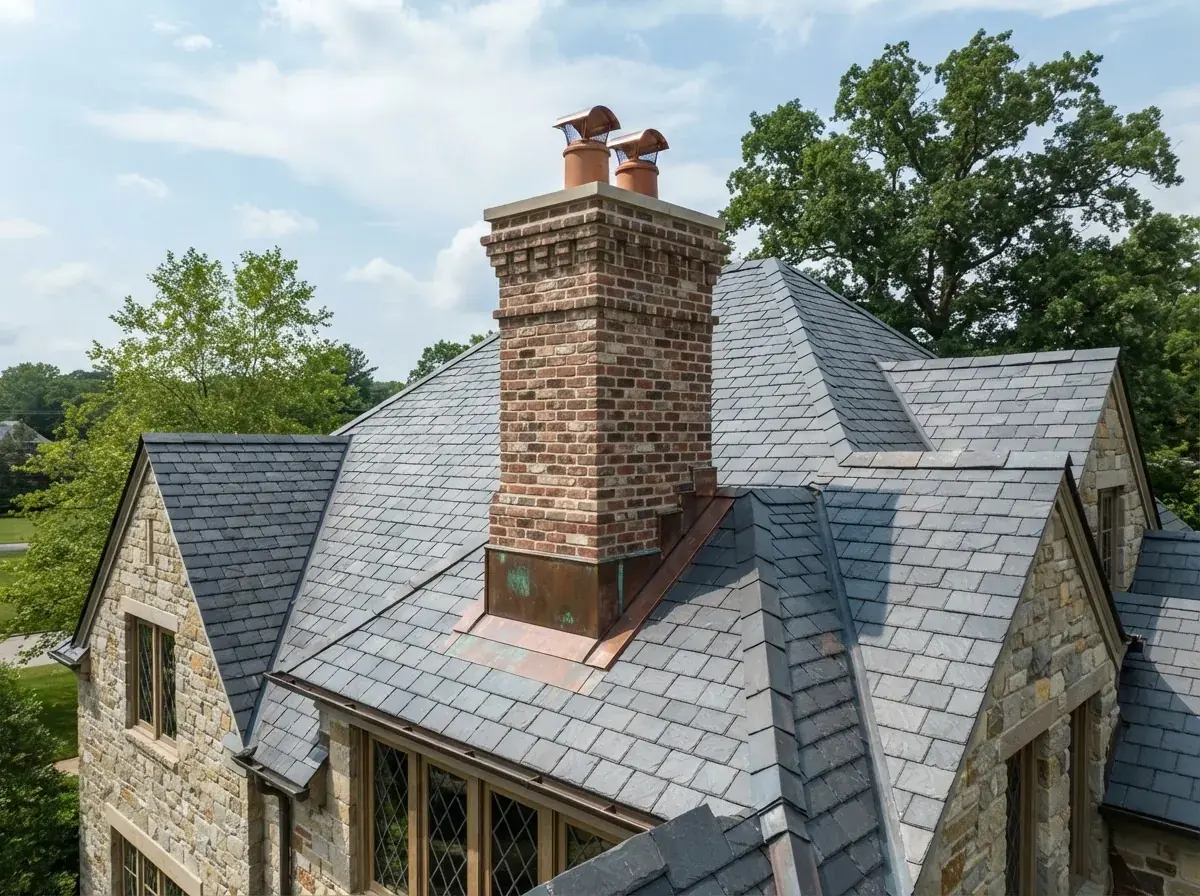
- Step and counter flashing in copper
- Crickets behind wide chimneys
- Crown, cap and mortar checked together
- Slates or tiles lifted and reset, not broken
Types of Chimney Flashing Repair
Step flashing
L-shaped pieces woven into each course of slate, tile or shakes along the sides of the chimney. Each piece overlaps the one below, so water steps down and out.
Counter flashing
Metal set into a mortar joint (a reglet cut into the brick) and folded down over the step flashing. It's what keeps water from running behind the step flashing.
Crickets and saddles
A small peaked roof built on the uphill side of a chimney to split water around it. Wide chimneys need one; without it, water and debris pond against the brick.
Apron (front) flashing
The single piece across the downhill face of the chimney, lapped over the roofing below.
Crown and cap repair
The concrete or mortar crown on top of the chimney cracks over time and lets water into the masonry from above. A rain cap keeps water out of the flue.
Repointing
Eroded mortar joints are raked out and refilled. Bad joints let water through the brick and past even good flashing.
Why Chimneys Leak When the Roof Is Fine
A chimney is a hole in the roof surrounded by masonry that moves at a different rate than the framing. Over decades, that movement, freeze-thaw cycles and the weather open gaps. The usual culprits:
- Tar or caulk patches in place of proper counter flashing. They look fine for a year or two, then crack.
- Face-nailed or surface-mounted counter flashing held on with sealant instead of being set into the mortar joints.
- Aluminum flashing in contact with mortar, which corrodes it, or next to copper.
- No cricket behind a chimney wider than about 30 inches, so water and leaves pond there.
- Cracked crowns and soft mortar, letting water into the brick above the flashing.
The 30-inch rule comes from the model building codes, which require a cricket or saddle behind chimneys wider than 30 inches measured across the slope. Connecticut and New York both build their codes on the International Residential Code.
How Chimney Flashing Is Replaced
- Find the real entry point. Stains inside don't always sit under the leak. A careful inspection checks flashing, crown, mortar, and the flue liner before blaming any one part.
- Lift the roofing. Slates or tiles around the chimney are removed with a slate ripper so they can go back. On cedar, shakes are lifted or replaced.
- Cut reglets. A groove is cut into the mortar joints for the new counter flashing.
- Build a cricket if the chimney is wide, framed and covered in copper.
- Install step, apron and counter flashing, usually in copper on slate and tile roofs, soldered at the corners.
- Re-lay the roofing with copper nails or hooks, and repoint or repair the crown as needed.
What Affects the Cost of Chimney Flashing Repair
Most jobs fall in the $1,200–$4,000 range. Expect the higher end when:
- the chimney is wide, tall, or on a steep slate roof that needs staging;
- a cricket has to be built from scratch;
- the masonry needs repointing, a new crown, or a partial rebuild above the roofline;
- the roof is natural slate or clay tile and many pieces must be lifted and reset;
- there are several chimneys, which is common on older Greenwich and Bedford houses.
Ranges are typical for Fairfield County and Westchester in 2026 and are for planning only. They are not quotes; the real price depends on the roof, access and materials.
Copper or Lead-Coated Copper on Older Houses
On slate and tile roofs, copper is the standard flashing because it lasts about as long as the roof. Lead-coated copper is a common alternative where the bright copper color would clash with stone or painted trim, and where the runoff shouldn't stain light masonry. Aluminum is the budget option, but it's a poor partner for mortar and copper and won't last as long as slate. Many old chimneys around the Sound have original copper that's sound but was patched with tar later; removing the tar and properly resetting counter flashing can be enough.
Signs the Chimney Flashing Is Failing
- Water stains on the ceiling or wall beside the chimney, often worse after wind-driven rain during a nor'easter.
- Damp or white-stained (efflorescent) brick in the attic around the chimney.
- Black tar or caulk smeared along the joint between brick and roof, a sign of earlier patching.
- Counter flashing pulled out of the mortar joint, or mortar crumbling where it's set.
- Slates or tiles beside the chimney cracked, slipped or missing.
- Leaves and debris piled behind the chimney, where a cricket should be.
Several of these can be seen from the ground with binoculars or from the attic with a flashlight. If you spot them, have the chimney looked at before winter, because freeze-thaw cycles widen every gap that water gets into.
Questions to Ask Before Hiring
- Will the counter flashing be set into cut reglets in the mortar, or fixed to the face of the brick?
- What metal will be used for step, counter and apron flashing, and in what weight?
- Does the chimney need a cricket, and is it included?
- How will the slates or tiles around the chimney be removed and reset, and what happens if some break?
- Are the crown, cap and repointing part of the price, or extra?
- Is the contractor registered with the Connecticut Department of Consumer Protection, or does it hold a Westchester County home improvement license for work in New York?
Before you hire
Check the Contractor First
Roofing on an existing home is home improvement in Connecticut: the contractor must be registered with the Department of Consumer Protection and show the HIC number in its ads and contract. Westchester County licenses home improvement contractors the same way.
- Look up a Connecticut HIC registration
- Search Westchester County licences
- Questions to ask a slate or cedar roofer
This site is an independent guide. It doesn't perform roofing work or recommend a particular company.